
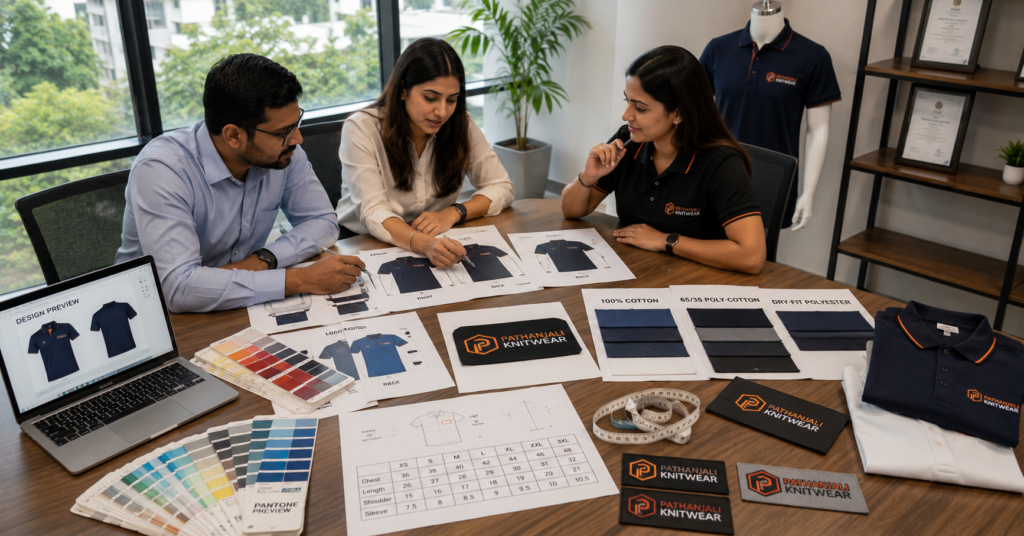
Designing custom company T-shirts is more than choosing a color and adding your logo. A well-prepared company T-shirt design brief helps your manufacturer understand exactly what you need, reducing production delays, costly revisions, and communication errors.
Whether you’re ordering uniforms for employees, promotional T-shirts for an event, or branded apparel for a marketing campaign, a detailed design brief ensures everyone involved—from your marketing team to the garment manufacturer—is working from the same plan.
In this guide, you’ll learn what to include in a professional T-shirt design brief, common mistakes to avoid, and you’ll get a free template you can use for your next bulk order.
Why a T-Shirt Design Brief Is Important
A design brief acts as the blueprint for your custom apparel project. It communicates your branding requirements, garment specifications, printing preferences, sizing, and delivery expectations before production begins.
A clear design brief helps you:
- Reduce artwork revisions
- Speed up quotation and sampling
- Prevent printing mistakes
- Ensure brand consistency
- Improve communication with manufacturers
- Deliver projects on schedule
Instead of answering multiple clarification emails, your supplier can immediately begin preparing artwork proofs and production samples.
What Should a Company T-Shirt Design Brief Include?
1. Project Overview
Start by explaining the purpose of your order.
Examples include:
- Employee uniforms
- Promotional campaigns
- Corporate events
- Trade exhibitions
- Product launches
- College festivals
- Marathon events
- Brand awareness campaigns
Mention where and how the T-shirts will be used, as this influences fabric selection and printing methods.
2. Company Branding
Provide complete branding guidelines.
Include:
- Company logo
- Approved logo variations
- Brand colors
- Typography
- Brand guidelines (if available)
Always provide high-resolution vector files such as AI, EPS, or PDF to ensure crisp printing.
3. Fabric Selection
Choosing the right fabric is essential for comfort, durability, and print quality.
Popular options include:
| Fabric | Best For |
|---|---|
| 100% Cotton | Employee uniforms |
| Poly-Cotton | Daily corporate wear |
| Polyester | Sports and events |
| Dry-Fit Fabric | Outdoor campaigns |
For most corporate T-shirts, 160–180 GSM cotton or poly-cotton provides the ideal balance between comfort and durability.
4. Garment Style
Specify exactly what type of garment you require.
Options include:
- Round neck T-shirts
- Polo T-shirts
- Full sleeve T-shirts
- Hoodies
- Sweatshirts
- Jackets
Also mention:
- Men’s fit
- Women’s fit
- Unisex
- Regular fit
- Slim fit
5. Logo Placement
Clearly define where logos should appear.
Common placements include:
- Left chest
- Full front
- Upper back
- Sleeve
- Neck label
Whenever possible, include measurements rather than descriptions like “small logo.”
6. Printing Method
Different designs require different printing techniques.
Common methods include:
Screen Printing
Ideal for bulk orders with simple artwork and limited colors.
Embroidery
Suitable for premium corporate uniforms and polo shirts.
DTF Printing
Excellent for detailed graphics and smaller quantities.
Sublimation Printing
Best suited for polyester sportswear and event T-shirts.
If you’re unsure, ask your manufacturer to recommend the most suitable printing method based on your artwork and fabric.
7. Size Breakdown
Don’t simply specify the total quantity.
Instead, provide a complete size distribution.
Example:
| Size | Quantity |
|---|---|
| XS | 20 |
| S | 45 |
| M | 120 |
| L | 150 |
| XL | 80 |
| XXL | 35 |
Accurate size planning minimizes last-minute changes and reduces inventory issues.
8. Quantity Requirements
Mention:
- Total quantity
- Minimum reorder quantity
- Department-wise distribution
- Individual branch requirements (if applicable)
This helps manufacturers optimize production planning.
9. Timeline
Include important project dates such as:
- Artwork approval
- Sample approval
- Production deadline
- Delivery date
- Event date
Providing realistic timelines helps avoid unnecessary production pressure.
Common Mistakes to Avoid
Many companies face delays because of incomplete specifications.
Avoid these common mistakes:
- Sending low-resolution logos
- Forgetting brand colors
- Not specifying logo placement
- Ignoring fabric quality
- Skipping sample approval
- Ordering without size distribution
- Choosing printing methods without consulting the manufacturer
A little planning before production saves both time and money.
Free Company T-Shirt Design Brief Template
Use the checklist below for your next project.
Company Name:
Project Name:
Purpose:
Total Quantity:
Delivery Date:
Garment Type:
Fabric:
GSM:
Garment Color:
Logo Files Attached:
Brand Colors:
Printing Method:
Logo Placement:
Size Breakdown:
Packaging Requirements:
Delivery Address:
Approval Contact:
Additional Instructions:
Tips for Faster Approvals
To streamline the production process:
- Share all artwork in one folder.
- Include a visual mockup of the design.
- Confirm Pantone or brand color references.
- Approve digital proofs promptly.
- Review samples before mass production.
- Assign one person to manage approvals.
These practices reduce communication gaps and help your manufacturer deliver accurate results on time.
Final Thoughts
Creating a detailed company T-shirt design brief is one of the easiest ways to ensure a successful custom apparel project. It helps manufacturers understand your expectations, minimizes production errors, speeds up approvals, and keeps your branding consistent across every garment.
Whether you’re ordering employee uniforms, promotional T-shirts, event merchandise, or branded corporate apparel, investing a little time in preparing a clear design brief can save significant time and costs later in the production process.
Before requesting a quotation, gather your artwork, fabric preferences, logo placement details, and size breakdown into one document. A complete brief allows your apparel partner to provide accurate recommendations, faster quotations, and smoother production from sampling to final delivery.
If you’re planning your next bulk custom T-shirt order, working with an experienced manufacturer like Pathanjali Knitwear can help simplify the process with expert guidance on fabrics, printing techniques, branding, and production planning—ensuring your custom apparel reflects your brand professionally from start to finish.